The Tesla history you actually own.
Longitudinal battery degradation velocity, 70% warranty cutoff auditor, home versus Supercharger energy accounting, and curb-weight tire wear — kept 100% offline on your iPhone. Zero Tesla password required. Zero cloud GPS tracking. Zero vampire battery drain.
The private iPhone cockpit for electric vehicles
Clean, local-first telemetry designed specifically for electric drive trains. Zero useless oil change prompts, zero cloud accounts, and zero remote data storage.
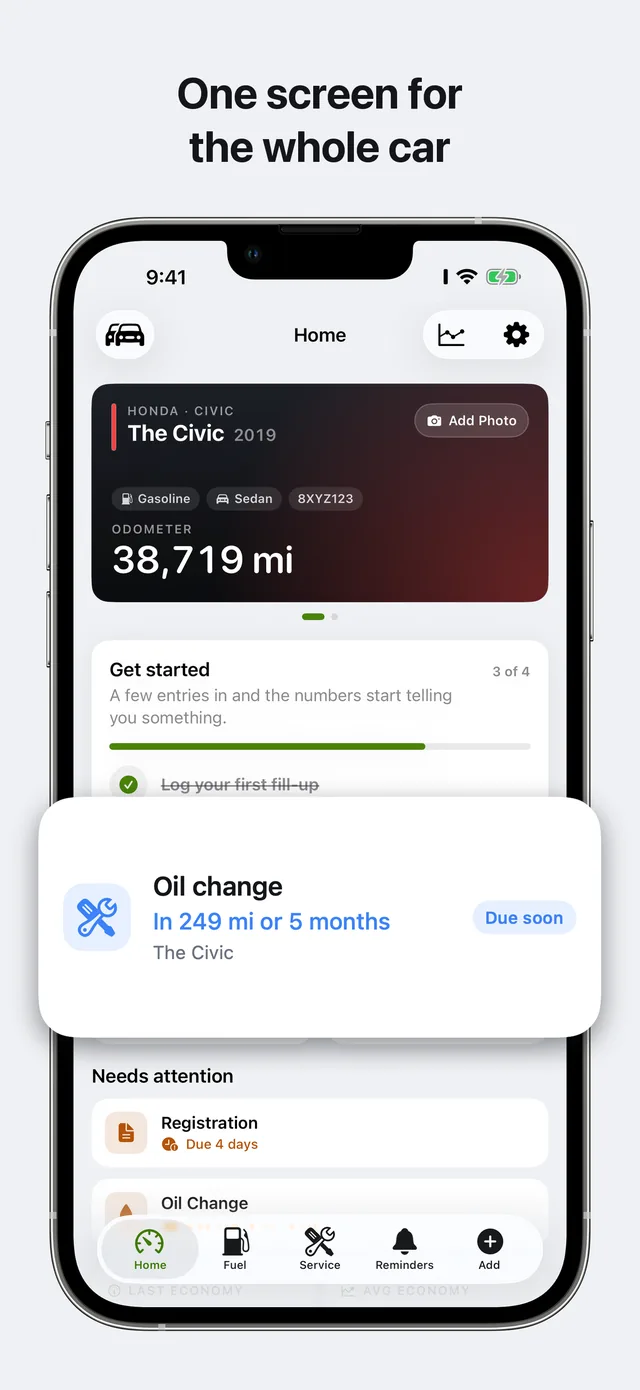 Telemetry Dashboard
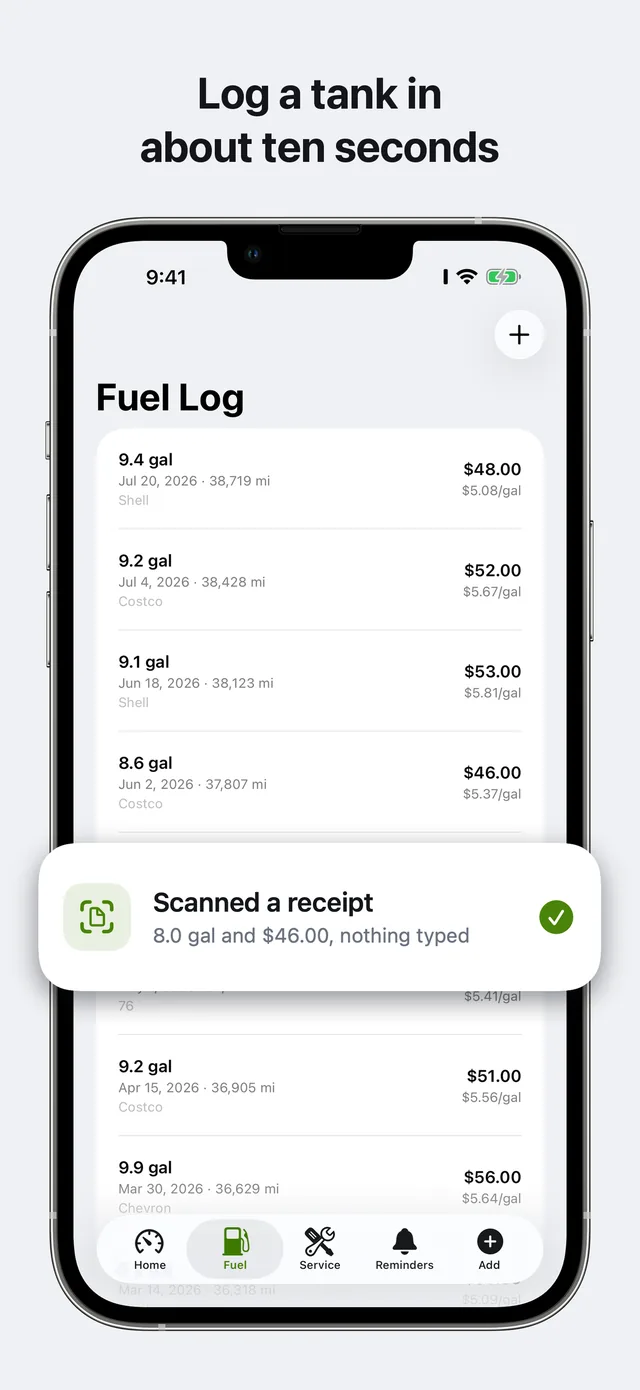 Granular kWh Charging Log
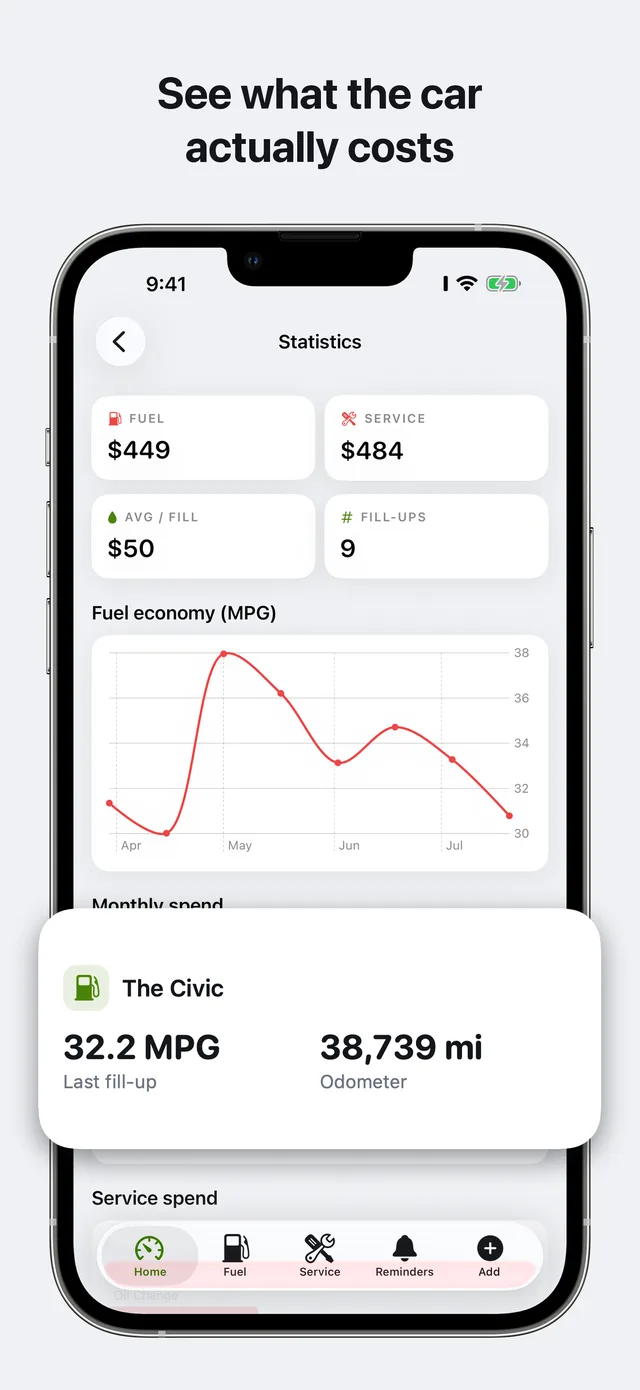 Cost Per Mile Analytics
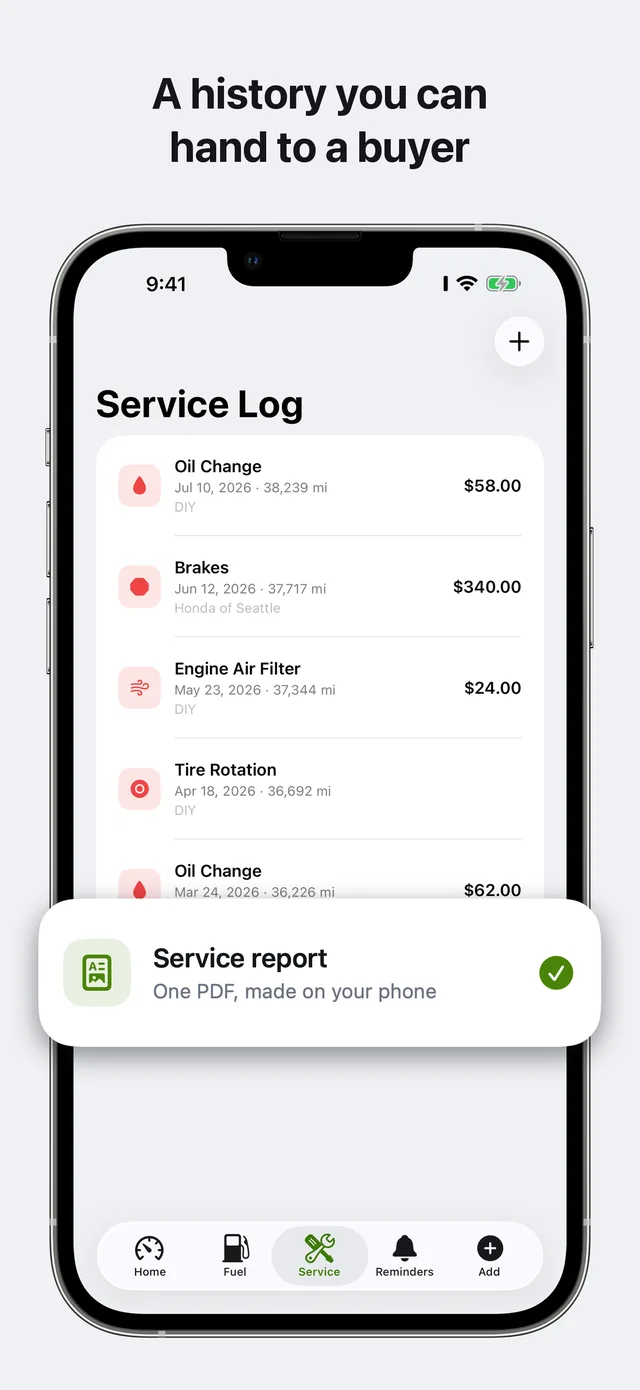 EV Consumables & PDF Export
Why third-party Tesla apps are a remote vehicle liability
Almost every Tesla tracking utility requires you to hand over your Tesla account password or OAuth refresh token. That token is stored on multi-tenant cloud servers and carries full Fleet API vehicle write permissions: unlocking doors, starting climate conditioning, enabling keyless drive, and logging your real-time GPS coordinates 24 hours a day.
Furthermore, cloud telematics apps repeatedly wake your car's onboard computer across cellular networks to poll telemetry, creating phantom battery drain (1 to 3 kWh lost every week just keeping the gateway awake). Carvico is built entirely local-first. Your records are stored in SwiftData on your iPhone and your personal iCloud private database container — with zero API login, zero remote commands, and zero battery drain.
| Security & Telemetry Criteria | Carvico (Local-First) | Cloud Telematics (Tessie, TezLab) | Dealership Lead Portals (Recurrent) |
|---|---|---|---|
| Tesla Account Credentials / Token | Zero credentials requested | Full vehicle OAuth token | OAuth token or OBD dongle |
| Remote Control Capabilities | Zero access (impossible) | Can unlock, start AC & drive | Read-only telematics token |
| Live GPS Telemetry Logging | Never logged or stored | Stored 24/7 on cloud servers | Periodic location logging |
| Vampire Battery Drain | 0% — car stays asleep | 1–3 kWh/wk wake requests | Periodic server wakeups |
| Underground Concrete Garages | Instant entry with 0 cell bars | Fails or times out without signal | Delayed until cellular reconnect |
| Data Storage Architecture | On-device & private iCloud | Multi-tenant cloud databases | Commercial valuation pool |
| Pricing Model | Free to start · No lock-in | $60–$180/year recurring subscription | Free tool · Dealership lead generation |
How to check and track Tesla battery health without an API login
The rated range displayed on your Tesla touchscreen is not an unpredictable driving estimate. Unlike dynamic "guess-o-meters" in older electric cars, Tesla derives displayed rated range from the Battery Management System's (BMS) internal calculation of nominal usable energy (kWh) divided by the vehicle's fixed EPA test constant (such as ~230 Wh/mi for a Model 3 RWD or ~260 Wh/mi for a Model Y Long Range).
This means your displayed rated range at a known State of Charge (SoC) directly reflects your pack's current usable capacity. Whenever you charge to 100% or note your displayed miles at a given percentage, enter the reading into Carvico. Carvico computes your nominal capacity retention against factory baseline, plots your degradation curve over months and years, and separates routine calibration drift from permanent cell degradation.
LFP versus NCA/NMC degradation
Lithium Iron Phosphate (LFP) packs in standard-range models have flat voltage curves that require regular 100% charges to prevent BMS calibration drift. Nickel chemistries (NCA/NMC) in Long Range and Performance variants degrade primarily from calendar aging and high cell voltage stress, making an 80% daily charge limit optimal.
70% retention threshold buffer
Tesla guarantees at least 70% usable battery capacity retention for 8 years or 100,000 to 120,000 miles. Carvico projects your degradation trajectory against this federal warranty cutoff so you know your exact buffer years before your coverage expires.
Separating BMS drift from cell decay
Repeated shallow charging cycles (e.g., 40% to 70%) cause the BMS to lose visibility into true cell open-circuit voltage, displaying an artificially low range figure. Carvico's longitudinal model highlights when an indicated drop is temporary calibration drift rather than permanent capacity loss.
Calculate home charging vs. Supercharger costs in true cents per mile
Tracking electric vehicle spending in lump-sum monthly dollars conceals your true efficiency. Electric vehicle energy costs vary by as much as 400% depending on where and when you charge: residential off-peak charging delivers power at $0.10 to $0.15/kWh (3.0 to 4.2 cents per mile), while commercial DC fast charging typically costs $0.38 to $0.52/kWh (11 to 15 cents per mile — comparable to fueling a 40 MPG hybrid).
Carvico provides granular energy accounting in electrical kilowatt-hours (kWh) alongside utility pricing. Log home charging sessions at your exact Time-of-Use (TOU) off-peak rate, track Supercharger sessions with receipt scanning, account for 10% to 15% AC-to-DC onboard charging losses, and monitor your real-world efficiency in mi/kWh (US) or kWh/100km (Metric).
Off-peak electricity scheduling
Residential time-of-use (TOU) electric tariffs offer significant discounts during overnight super-off-peak windows (typically 11 PM to 7 AM). Logging kWh at your off-peak rate establishes your true baseline running cost.
DC fast charging cost ledger
Public DC fast chargers (Tesla Supercharger, Electrify America, EVgo) bill at commercial demand rates. Carvico isolates public charging expenses from residential power to calculate true trip costs.
Real-world cost per mile comparison
Dashboard meters display pack-consumed energy, omitting onboard charging conversion losses. Carvico records metered wall energy to compute your unrounded cost per mile against equivalent gasoline vehicles.
Maintenance intervals built for heavy curb weights, not oil changes
Generic car maintenance apps treat electric vehicles like gasoline cars with missing engines. While electric vehicles eliminate motor oil, spark plugs, timing belts, and oxygen sensors, their heavy curb weight and high instant torque place unique stresses on chassis consumables.
A Tesla Model Y weighs 4,398 lbs — nearly 1,000 lbs more than an equivalent compact SUV. Combined with immediate electric torque and aggressive rear suspension camber, tires experience accelerated inner-shoulder wear. Carvico replaces irrelevant engine reminders with smart intervals tailored specifically for electric vehicles.
Accelerated tire wear & rotation
High vehicle mass and instant torque wear out tires 20% to 30% faster than internal combustion vehicles. Carvico tracks tire rotation intervals and tread depth measurements to ensure even wear and prevent premature replacement.
Cabin air & HEPA filtration
Electric vehicle climate systems circulate substantial airflow through large cabin filters. Replacing filters on schedule prevents musty evaporator odor and protects the heating, ventilation, and air conditioning system.
Brake fluid hygroscopic testing
Because regenerative braking handles over 90% of deceleration, friction brakes are rarely exercised. However, standard DOT 3/DOT 4 brake fluid still absorbs atmospheric moisture over calendar time, requiring moisture testing every 2 to 3 years.
Verified battery capacities and EPA baselines across EV models
Carvico maintains verified EPA laboratory figures, nominal battery capacities, and real-world efficiency benchmarks for all major production electric vehicles. Explore detailed running costs and range data for popular electric models:
Authoritative electric vehicle research and calculators
Tesla & EV ownership without cloud tracking
Why is zero API login safer than third-party Tesla apps?
Third-party cloud apps like Tessie or TezLab require your Tesla account OAuth token. That token is stored on multi-tenant cloud servers and grants broad vehicle write permissions: unlocking doors, starting drives, monitoring real-time GPS locations, and logging where you park overnight. In addition, continuous server polling prevents vehicle computers from sleeping, creating phantom drain. Carvico is 100% offline via SwiftData. Your vehicle records are stored exclusively on your iPhone and your personal iCloud private database container — zero API login, zero remote commands, zero vampire drain, and zero remote attack surface.
How does Carvico track Tesla battery health without an API login?
The rated range displayed on your Tesla dashboard is calculated directly by the vehicle's Battery Management System (BMS) from its internal nominal full pack capacity, divided by the fixed EPA test constant (for example, ~230 Wh/mi on Model 3 RWD). When you record your displayed miles at 100% state of charge (or your current miles alongside SoC percentage), Carvico computes your usable pack capacity retention against your vehicle's factory EPA baseline. Over time, it plots your longitudinal degradation velocity and benchmarks your pack retention against 20,000+ fleet curves to detect accelerated wear versus routine calibration drift.
How do I calculate the cost to charge a Tesla at home?
Multiply the total energy delivered by your home EVSE (or metered kWh) by your electric utility rate in $/kWh. For example, replenishing a 60 kWh pack at a residential off-peak rate of $0.13/kWh costs approximately $7.80 for 250 miles of travel (about 3.1 cents per mile). Carvico tracks energy in kWh, separates residential off-peak sessions from commercial DC fast charging, factors in Level 2 inverter conversion losses, and computes your true operational cost per mile.
What is the difference between BMS range drift and permanent battery degradation?
BMS range drift is an algorithmic calculation error that occurs when a battery is repeatedly charged in a narrow state-of-charge band (for example, 40% to 75%). The vehicle's management software loses precise calibration of the open-circuit voltage curve, temporarily displaying fewer rated miles. Permanent degradation is irreversible chemical capacity loss from solid-electrolyte interphase (SEI) layer growth, lithium plating, and active material dissolution. Carvico's longitudinal tracking separates temporary BMS drift from genuine degradation velocity.
What happens when a Tesla battery drops below 70% state of health?
Tesla's New Vehicle Limited Warranty covers battery capacity retention to a minimum of 70% over 8 years or 100,000 to 120,000 miles (depending on the vehicle trim). If usable capacity drops below 70% within the warranty window, Tesla is required to repair or replace the pack. Carvico models your degradation curve to project your buffer above this federal threshold well in advance of warranty expiration.
Why do electric vehicle tires wear out faster than gas cars?
Electric vehicles weigh 20% to 30% more than comparable internal combustion engine vehicles due to traction battery pack weight (for example, a Model Y weighs nearly 4,400 lbs). Combined with immediate stator torque off the line and rear-wheel camber, tires experience elevated shear stress and accelerated inner-shoulder wear. Carvico sets an aggressive starter rotation schedule of 6,000 miles (10,000 km) to preserve tire tread life and prevent premature replacement.
Does Carvico work for non-Tesla electric vehicles?
Yes. Carvico natively supports all battery-electric and plug-in hybrid platforms including Hyundai Ioniq 5 and Ioniq 6, Ford Mustang Mach-E and F-150 Lightning, Rivian R1T and R1S, Chevrolet Bolt and Equinox EV, Porsche Taycan, and BMW i4. Maintenance schedules are tuned specifically for electric vehicles, eliminating oil change prompts while tracking tire rotations, cabin microfilters, and brake fluid moisture tests.
Your Tesla history in a log you actually own.
Zero cloud logins. 100% offline via SwiftData and your private iCloud. Track your battery health, home versus Supercharger costs, and tire wear on your iPhone today.
Download on theApp Store iPhone · iOS 17 or later · Free to start · No account needed