Can You Keep Driving With Code P0501?
Driving with code P0501 active poses an immediate risk of permanent mechanical failure. Yes, but cruise control will not work. Continued driving can cause valve-to-piston contact, catalytic converter melting from raw fuel dumping, or sudden loss of vehicle motive power. We strongly recommend parking the vehicle or having it towed to a certified repair facility.
What Code P0501 Means
Trouble code P0501 is defined by standard SAE/ISO diagnostic protocols as Vehicle Speed Sensor Range/Performance. The engine control computer monitors this circuit and mechanical subsystem continuously through dedicated telemetry sensors. When sensor readings or calculated performance metrics deviate outside calibrated factory boundaries for more than two consecutive drive cycles, the computer records Freeze Frame diagnostic data and illuminates the Check Engine light on your instrument cluster.
How the Vehicle Speed Sensor (VSS) & Drivetrain Telemetry Operates
The Vehicle Speed Sensor (VSS) measures rotational speed of the transmission output shaft or differential ring gear, converting road wheel speed into electrical pulses for the ECM, transmission controller, cruise control, and speedometer cluster. On modern ABS-equipped vehicles, individual magnetic wheel speed sensors at each hub calculate vehicle speed by averaging telemetry across all four wheels.
Because speed sensors are mounted under the chassis exposed to road splash, slush, and brake dust, harness connectors frequently corrode. If the VSS signal drops out while driving, the transmission loses its road-speed reference, causing harsh gear shifts, sudden speedometer needle drops to zero, and the immediate disengagement of cruise control.
The Most Common Diagnostic Mistake
Check ABS Wheel Speed PIDs First: On vehicles built after 2008, vehicle speed is often calculated not by a transmission VSS, but by the ABS module reading all four wheel speed sensors over the CAN bus. If your speedometer stops working and speed codes set, connect a scan tool to the ABS module and check individual wheel speeds. A single rusted wheel speed sensor or cracked tone ring on a rear axle will disable vehicle speed calculation.
Common Symptoms & Driving Observations
When code P0501 triggers, drivers typically report one or more of the following physical driving symptoms:
- Speedometer needle jumping up and down: Typical driving observation associated with Vehicle Speed Sensor (VSS) & Drivetrain Telemetry malfunctions under real-world road conditions.
- Erratic transmission shifts: Harsh gear engagement, slipping between shifts, or delayed upshifts during acceleration.
- Check Engine light on: Illuminates steady on the dashboard to warn that onboard telemetry exceeded calibrated limits for two drive cycles.
Diagnostic Triage: Likely Causes & First Checks
To avoid spending money on unneeded parts, triage the most frequent failure points starting with the easiest and least expensive DIY checks first:
| Likely Cause | Subsystem | Triage Priority | Diagnostic Action |
|---|---|---|---|
| Worn speed sensor tone ring | Vehicle Speed Sensor (VSS) & Drivetrain Telemetry | Check First (DIY) | Inspect sensor tone ring for missing teeth. |
| Failing speed sensor | Vehicle Speed Sensor (VSS) & Drivetrain Telemetry | DIY Inspection | Replace Vehicle Speed Sensor. |
| Damaged sensor connector | Vehicle Speed Sensor (VSS) & Drivetrain Telemetry | Bench Test | Inspect sensor tone ring for missing teeth. |
Step-by-Step Diagnostic Protocol
Follow this systematic 4-step diagnostic protocol before ordering replacement parts:
Compare All 4 Wheel Speeds Live in ABS Data Stream [OBD-II Scan Tool with ABS Live Data]
Drive the vehicle in a straight line at 25 MPH while logging Front Left, Front Right, Rear Left, and Rear Right wheel speed PIDs.
Pass/Fail: All four wheels should read identically within 0.5 MPH. A sensor reading 0 MPH or spiking erratically isolates the exact failed wheel.
Inspect Wheel Hub Reluctor Tone Ring for Cracks [Flashlight & Wire Brush]
Inspect the toothed reluctor ring on the axle shaft or the magnetic encoder seal embedded in the wheel hub bearing.
Pass/Fail: Ring teeth must be clean and uncracked. Rust swelling beneath the tone ring frequently splits the ring, creating erratic speed pulses.
Test Sensor Internal Coil Resistance [Digital Multimeter (Ohms)]
Unplug the 2-pin passive speed sensor connector. Measure resistance across the sensor terminals.
Pass/Fail: Passive inductive sensors typically measure 800Ω–1,600Ω. Infinite resistance indicates an open circuit winding inside the sensor.
Inspect Wiring Harness Along Suspension Control Arms [Hands & Flashlight]
Trace the flexible sensor harness from the wheel knuckle up into the chassis body. Flex the wire near mounting clips.
Pass/Fail: Harness must be pliable with zero internal copper fatigue breaks caused by continuous suspension travel.
Estimated Repair Costs: DIY vs Professional Shop
Average repair pricing based on OEM parts, standard labor times, and national independent repair shop rates:
| Repair / Replacement Stage | DIY Parts Only | Independent Mechanic | Dealership Service |
|---|---|---|---|
| ABS Wheel Speed Sensor Replacement | $30 – $75 | $120 – $210 | $190 – $320 |
| Transmission Vehicle Speed Sensor (VSS) | $40 – $95 | $140 – $240 | $220 – $360 |
| Axle Tone Ring / Hub Bearing Replacement | $85 – $190 | $280 – $480 | $440 – $720 |
Related Field Guides & Cost Tools
Calculate baseline annual maintenance funds and unexpected repair reserves for aging vehicles.
Calculate your true cost of ownership, compare DIY savings against mechanic labor rates, and estimate your running cost per mile.
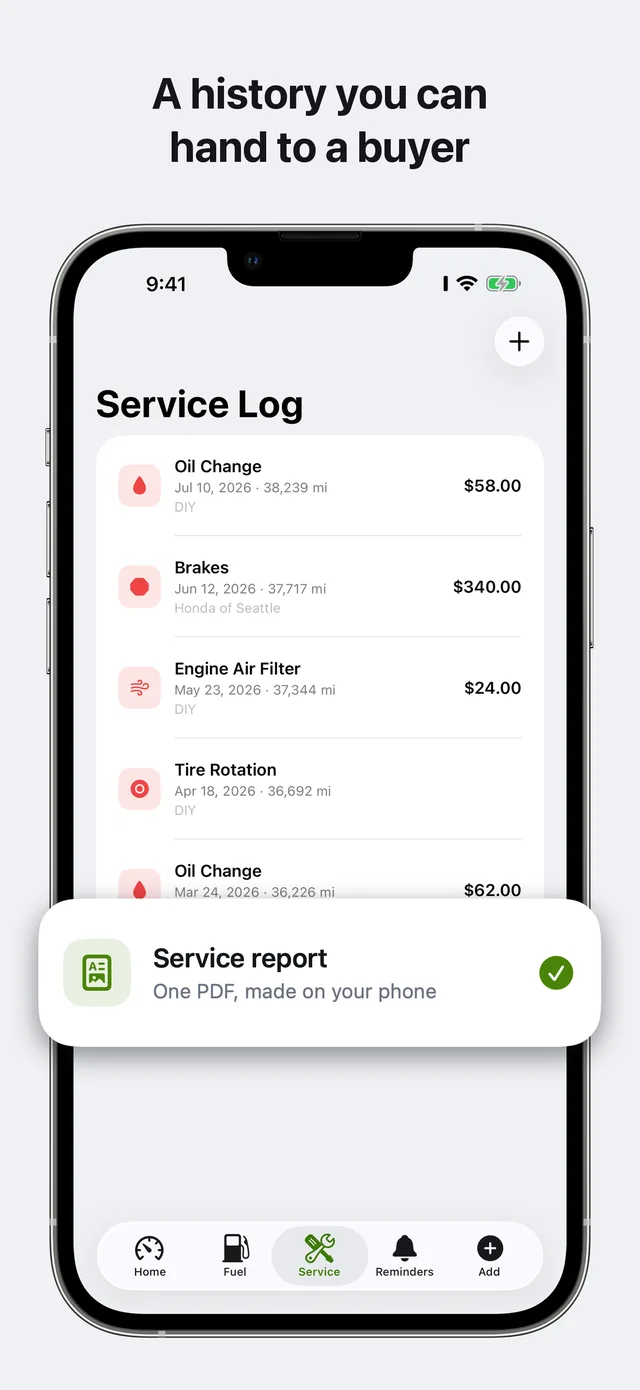
Never lose another repair receipt or fuel log
Keep your complete service history, real full-tank MPG, and diagnostic records organized on your iPhone. Carvico alerts you before service is overdue and gives you verified PDF records when you sell — 100% private on your own iCloud with zero ads.
Related Diagnostic Codes
Camshaft Position Actuator Circuit (Bank 1)
Electrical circuit fault in the intake variable valve timing (VVT) solenoid on cylinder Bank 1.
P0011Camshaft Position 'A' Timing Over-Advanced (Bank 1)
The intake camshaft timing on Bank 1 is further advanced than the ECU commanded.
P0012Camshaft Position 'A' Timing Over-Retarded (Bank 1)
The intake camshaft timing on Bank 1 is lagging behind the computer's commanded timing advance.
P0013Exhaust Camshaft Position Actuator Circuit (Bank 1)
Electrical fault detected in the exhaust variable valve timing (VVT) solenoid circuit on Bank 1.