Can You Keep Driving With Code P0420?
You can typically drive short distances to a qualified repair shop, provided the Check Engine light remains solid and is not flashing. Yes for short trips, but prolonged driving with rich exhaust can overheat, melt, or completely clog the catalyst. However, operating under this condition forces the engine control module into altered fuel or timing strategies, accelerating wear on emissions hardware and reducing power under load. Inspect vital fluids before driving.
What Code P0420 Means
Trouble code P0420 is defined by standard SAE/ISO diagnostic protocols as Catalyst System Efficiency Below Threshold (Bank 1). The engine control computer monitors this circuit and mechanical subsystem continuously through dedicated telemetry sensors. When sensor readings or calculated performance metrics deviate outside calibrated factory boundaries for more than two consecutive drive cycles, the computer records Freeze Frame diagnostic data and illuminates the Check Engine light on your instrument cluster.
How the Catalytic Converter & Exhaust Purification Operates
The catalytic converter uses a ceramic honeycomb substrate wash-coated with precious metals (platinum, palladium, and rhodium) to oxidize harmful exhaust gases. It converts carbon monoxide (CO) and unburned hydrocarbons (HC) into carbon dioxide and water, while reducing nitrogen oxides (NOx) into nitrogen. The converter functions as a chemical chemical sponge, storing oxygen during lean pulses and releasing it during rich pulses to sustain oxidation.
The ECM continuously monitors catalytic converter health by comparing upstream and downstream oxygen sensor signals. On a healthy converter, the upstream sensor oscillates rapidly while the downstream sensor produces a steady, smooth 0.45V line because all free oxygen was consumed in the converter. When the catalyst washes out, melts, or loses oxygen storage capacity, downstream sensor oscillations begin mirroring the upstream sensor, triggering efficiency trouble codes.
The Most Common Diagnostic Mistake
Don't Replace Catalytic Converters Without Fixing Root Cause: Catalytic converters do not die of old age—they are killed by upstream engine faults. Unburned fuel from an ignored misfire will enter the converter and ignite inside the substrate, melting the honeycomb core at 2,000°F in under 50 miles. Similarly, burning oil from worn valve guides or coolant from a head gasket coats the precious metal catalyst in glaze. If you install a new $1,200 converter without curing the misfire or oil consumption, the new converter will fail within months.
Common Symptoms & Driving Observations
When code P0420 triggers, drivers typically report one or more of the following physical driving symptoms:
- Check Engine light illuminated on dashboard: Illuminates steady on the dashboard to warn that onboard telemetry exceeded calibrated limits for two drive cycles.
- Noticeable drop in fuel economy (MPG): Causes 10% to 25% drop in full-tank fuel economy due to open-loop enrichment or inefficient cam phasing.
- Sulfur or rotten egg smell from the tailpipe: Noticeable near the rear tailpipe or through cabin ventilation vents while idling in traffic.
- Sluggish acceleration when merging onto highways: Felt as a flat spot or delayed throttle response when attempting to merge or pass on the highway.
Diagnostic Triage: Likely Causes & First Checks
To avoid spending money on unneeded parts, triage the most frequent failure points starting with the easiest and least expensive DIY checks first:
| Likely Cause | Subsystem | Triage Priority | Diagnostic Action |
|---|---|---|---|
| Failing or degraded catalytic converter (Bank 1) | Catalytic Converter & Exhaust Purification | Check First (DIY) | Scan freeze frame data to compare Bank 1 upstream and downstream O2 sensor waveforms. |
| Faulty downstream O2 oxygen sensor sending inaccurate readings | Catalytic Converter & Exhaust Purification | DIY Inspection | Inspect exhaust pipes for visible rust cracks, holes, or loose heat shields before buying parts. |
| Exhaust leak before or near the catalytic converter | Catalytic Converter & Exhaust Purification | Bench Test | Check for upstream misfire codes (such as P0300 or P0301) dumping raw fuel into the exhaust. |
| Engine misfires dumping unburned fuel directly into the exhaust | Catalytic Converter & Exhaust Purification | Shop Diagnostic | Replace downstream O2 sensor first if voltage fluctuates identically to the upstream sensor. |
Step-by-Step Diagnostic Protocol
Follow this systematic 4-step diagnostic protocol before ordering replacement parts:
Graph Upstream vs Downstream O2 Sensor Signals [OBD-II Scanner with Dual-Channel Graphing]
Warm the vehicle to operating temperature and drive on the highway for 15 minutes. Graph Bank 1 Sensor 1 alongside Bank 1 Sensor 2 at a steady 55 MPH cruise.
Pass/Fail: Sensor 1 must cycle rapidly between 0.1V and 0.9V while Sensor 2 stays smooth near 0.45V–0.7V. If Sensor 2 mirrors Sensor 1 with rapid switching, catalyst oxygen storage capacity is depleted.
Measure Inlet vs Outlet Operating Temperatures [Infrared Thermal Thermometer]
With the engine fully hot and idling at 1,500 RPM, aim the infrared thermometer at the converter inlet weld ring, then measure the outlet weld ring. An actively functioning catalyst generates an exothermic chemical reaction.
Pass/Fail: The outlet weld ring should measure 30°F to 100°F hotter than the inlet. An outlet that is colder than the inlet indicates a dead catalyst.
Check Exhaust Backpressure for Internal Restriction [Exhaust Backpressure Gauge (Threads into O2 Port)]
Unthread the upstream O2 sensor and thread in a low-pressure 0–15 PSI gauge. Start engine and observe backpressure at idle and at 2,500 RPM.
Pass/Fail: Backpressure must register below 1.5 PSI at idle and under 3.0 PSI at 2,500 RPM. Higher readings indicate a melted, collapsed, or clogged substrate core.
Examine Freeze-Frame Data for Historic Misfire Codes [OBD-II Scan Tool]
Review stored Freeze Frame and Mode $06 data for past misfires on cylinders feeding that exhaust bank. Confirm whether P0300, P0301-P0308, or rich fuel trims preceded the catalytic code.
Pass/Fail: Must verify all ignition coils, plugs, and injectors are delivering balanced combustion before approving converter replacement.
Estimated Repair Costs: DIY vs Professional Shop
Average repair pricing based on OEM parts, standard labor times, and national independent repair shop rates:
| Repair / Replacement Stage | DIY Parts Only | Independent Mechanic | Dealership Service |
|---|---|---|---|
| Direct-Fit Catalytic Converter (Aftermarket) | $280 – $650 | $650 – $1,100 | $1,200 – $2,200 |
| OEM Factory Catalytic Converter Assembly | $650 – $1,400 | $1,100 – $1,900 | $1,800 – $3,200 |
| Upstream/Downstream O2 Sensor Pair | $120 – $240 | $280 – $450 | $450 – $750 |
Related Field Guides & Cost Tools
How oxygen sensors, exhaust restrictions, and fuel trims alter fuel consumption before check engine lights flash.
Calculate your true cost of ownership, compare DIY savings against mechanic labor rates, and estimate your running cost per mile.
Never lose another repair receipt or fuel log
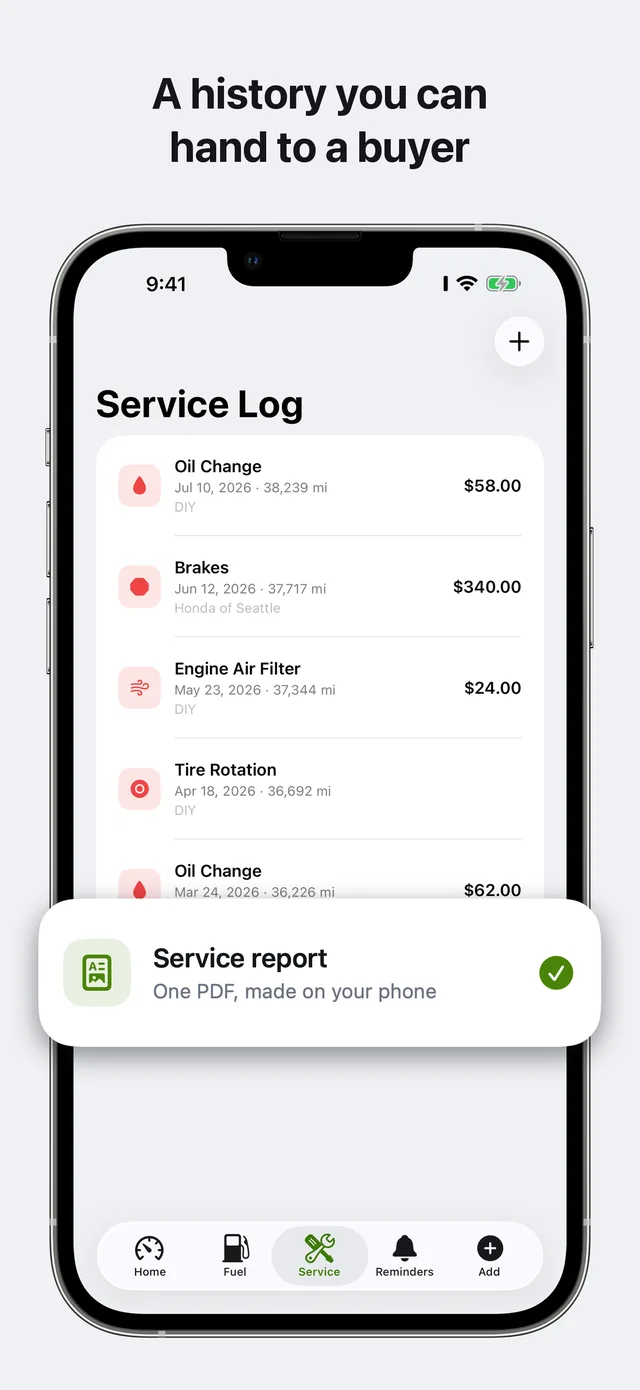
Keep your complete service history, real full-tank MPG, and diagnostic records organized on your iPhone. Carvico alerts you before service is overdue and gives you verified PDF records when you sell — 100% private on your own iCloud with zero ads.
Related Diagnostic Codes
Camshaft Position Actuator Circuit (Bank 1)
Electrical circuit fault in the intake variable valve timing (VVT) solenoid on cylinder Bank 1.
P0011Camshaft Position 'A' Timing Over-Advanced (Bank 1)
The intake camshaft timing on Bank 1 is further advanced than the ECU commanded.
P0012Camshaft Position 'A' Timing Over-Retarded (Bank 1)
The intake camshaft timing on Bank 1 is lagging behind the computer's commanded timing advance.
P0013Exhaust Camshaft Position Actuator Circuit (Bank 1)
Electrical fault detected in the exhaust variable valve timing (VVT) solenoid circuit on Bank 1.